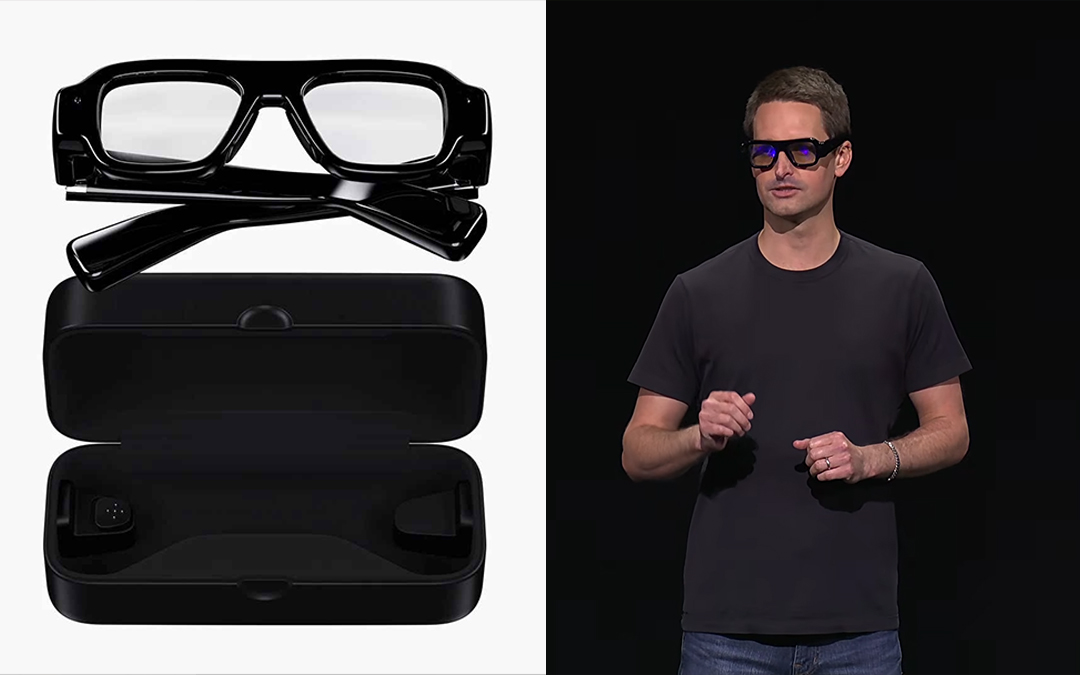
Snap has revealed a major expansion of its SPECS augmented reality glasses, adding an anticipatory AI service, new AR applications, enterprise partnerships and a cellular charging case as it prepares to ship the $2,195 wearable computer later this fall.
The September 16 update gives a much clearer picture of Snap's ambitions for SPECS. Rather than positioning the device primarily as smart glasses for capturing photos, talking to an AI assistant or displaying notifications, Snap is building SPECS as a standalone spatial computing platform with see-through displays, hand and voice controls, its own operating system and computing hardware integrated directly into the glasses.
The company is also pursuing consumer and enterprise markets simultaneously. New partnerships with NVIDIA, Amazon Web Services, Salesforce, Trifork and Hololight are intended to bring SPECS into workplaces including factories, retail environments and field operations.
SPECS Intelligence brings anticipatory AI to Snap's AR glasses
The headline software announcement is SPECS Intelligence, an AI service designed to work across SPECS, iPhone and Mac.
The distinction Snap is emphasizing is anticipation. Instead of requiring the user to ask an AI assistant for everything, SPECS Intelligence is designed to build context around goals, routines, priorities and relationships using apps and services that the user chooses to connect. It can then surface information when Snap's system determines that it could be useful.
For example, ahead of a meeting, the system could identify decisions that need to be made or information worth remembering. For travel, it could organize flight, hotel and restaurant information while also identifying work commitments that overlap with the trip.
SPECS extend that concept into augmented reality. A traveler could ask "Hey SPECS" for flight information, hotel details and reservations, with relevant information appearing within the wearer's field of view. The glasses can also provide a briefing about the wearer's upcoming day.
SPECS Intelligence does not require the glasses. Snap has released an iOS preview in the US for people aged 18 and over, while the fuller early-access version will initially be available by invitation through the SPECS Mac app.
The iOS preview currently has more limited functionality. Users can connect a Google account to receive insights based on Gmail and Google Calendar, but the mobile preview does not yet provide the broader anticipatory suggestions and actions Snap describes for the full service.
What can Snap SPECS actually do?
Snap's latest demonstrations provide a better sense of what it expects people to use display-equipped AR glasses for.
SPECS use see-through lenses to position digital content within three-dimensional space. Computing hardware is incorporated into the glasses, so there is no external compute puck or tether. SPECS OS supports interaction through hands and voice rather than relying exclusively on conventional controllers.
Navigation can overlay directions onto the wearer's surroundings. Translation can display real-time subtitles for someone speaking another language, with Snap claiming support for 60 languages.
For entertainment, the SPECS browser can display streaming content from services including YouTube and HBO Max on a virtual screen that Snap says appears comparable to a 115-inch display viewed from around 10 feet away. Spotify integration provides music playback.
Snap is also working with the NBA and WNBA on basketball experiences that can place visual guidance, practice drills and progress information into the physical environment. Soccer and golf training experiences are also planned.
Education is another target. An Apollo 11 experience recreates the Moon mission, while Starmap places constellation information over the night sky.
The glasses can also connect wirelessly to a computer and create a spatial workspace beyond a conventional monitor. Bluetooth peripherals such as keyboards are supported, while a Whiteboard application provides an environment for diagrams, brainstorming and workflow organization.
Shared AR could differentiate SPECS from simpler smart glasses
One of the more significant capabilities is Connected Lenses.
Two SPECS users can experience digital content anchored within the same physical space. Initial examples include chess, table tennis and a dominoes experience featuring Jimmy Butler.
Shared spatial computing is an important distinction between full AR glasses and the rapidly expanding category of AI smart glasses.
Many current smart glasses concentrate on cameras, microphones, speakers and AI assistance without placing spatial digital imagery directly into the wearer's view. SPECS are attempting something more technically demanding: understanding physical space, rendering see-through AR content and allowing multiple people to interact with that content together.
That capability also creates possibilities beyond games. Shared spatial information could eventually matter for collaborative design, training, maintenance and other workplace applications.
Snap is making a serious enterprise AR push
Snap is not relying solely on consumers to justify a $2,195 pair of glasses.
The company announced collaborations with Salesforce, NVIDIA, AWS, Trifork and Hololight aimed at enterprise deployments. Reuters reports that Snap is positioning SPECS for hands-free computing in environments such as factory floors, retail stores and field service operations.
The basic proposition is familiar from earlier generations of enterprise AR: give a worker access to digital information without requiring them to stop what they are doing and look at a laptop, tablet or phone.
What changes is the surrounding software and AI ecosystem.
Rather than simply displaying instructions, newer AR systems can potentially combine computer vision, contextual AI, enterprise data and spatial interfaces. A field technician, for example, could access relevant information while looking at equipment and keeping both hands available for the task.
Snap says it is also developing the management and security capabilities needed for organizations to deploy SPECS at scale.
The partnerships give Snap credible enterprise technology integrations, but partnerships themselves do not prove large-scale adoption. Reuters noted that the company is entering a competitive AR and smart-glasses market, so actual deployments and measurable workplace benefits will be important indicators to watch.
A cellular charging case makes SPECS less dependent on Wi-Fi
Snap also introduced the SPECS Charging Case with Cellular.
The accessory provides four additional charges and cellular connectivity through participating carriers, allowing the glasses to remain connected when Wi-Fi is unavailable.
In the US, Snap is working with Verizon. The SPECS Connected Case bundle will cost $2,395, while Verizon connected wearable plans will start at $10 per month for existing Verizon customers and $20 per month for non-Verizon customers.
Orange will support the product in France and EE in the UK, although Snap has not yet announced pricing for those carrier plans.
The cellular case is more important than a conventional battery accessory because connectivity remains one of the practical constraints on wearable computing. If AR glasses are intended to replace some tasks currently performed on phones and computers, users need them to remain useful while moving between locations.
Snap is also addressing the privacy problem surrounding smart glasses
As cameras become normal components of eyewear, privacy is becoming a major issue for the entire smart-glasses market.
Snap says SPECS do not use facial recognition to identify people and do not continuously record or save audio, photos or video in order to understand the environment.
When the wearer intentionally captures a photo, video or audio, an external LED on the center of the frame illuminates or flashes to indicate that recording is taking place.
For SPECS Intelligence, Snap says users choose which accounts and information they connect. According to the company, personal content from connected accounts will not be used to train or fine-tune its AI models or to serve personalized advertising. Processing is split between on-device systems and secure cloud infrastructure.
These safeguards will matter increasingly as smart glasses move into workplaces and public spaces. Their effectiveness will also need to be judged through real-world use, particularly as wearable cameras become less conspicuous.
Snap SPECS price, pre-orders and release date
SPECS cost $2,195 and can currently be pre-ordered with a refundable $200 deposit. Snap expects shipments to begin later this fall in the United States, United Kingdom and France.
Consumers will also be able to try the hardware at SPECS First Look at Westfield Century City in Los Angeles beginning October 1.
The price puts SPECS well outside the territory of conventional consumer eyewear. Independent coverage has consequently raised questions about how broad the initial consumer audience can be. TechCrunch described the hardware as expensive and potentially beyond what casual consumers are prepared to pay.
That helps explain why Snap's enterprise announcement matters. Professional applications can support very different purchasing economics when hardware saves workers time, improves remote assistance or reduces errors.
SPECS are becoming a test of whether AR glasses can become a computing platform
Snap has been working toward this moment for more than a decade. In 2025, the company said it had invested more than $3 billion over 11 years developing its approach to augmented reality computing. In January 2026, it established Specs Inc. as a wholly owned subsidiary, giving the hardware business its own organizational identity within Snap.
The September announcement makes the strategy easier to see.
Snap is combining see-through AR displays, spatial computing, AI, a dedicated operating system, developer tools, connectivity and enterprise integrations rather than treating glasses as a peripheral for a smartphone.
There are still substantial questions. A $2,195 starting price restricts the addressable consumer market. Comfort, battery life, visual quality, developer support and usefulness over extended periods will matter more once customers receive production hardware. Enterprise partnerships also need to translate into deployments rather than demonstrations.
Still, SPECS represent a particularly interesting branch of the current smart-glasses market because Snap is pursuing genuine visual augmented reality rather than limiting the product to cameras, audio and AI.
If that approach succeeds, the competition in smart glasses may not simply be about putting an assistant on your face. It will be about whether lightweight eyewear can become a practical spatial computer.
Sources
Snap Inc., "SPECS Make Computing More Human with New Experiences, Partnerships, and SPECS Intelligence," September 16, 2026.
Snap Inc., "Snap Inc. Introduces SPECS Intelligence, an Anticipatory AI Service," September 16, 2026.
Snap Inc., "Snap Inc. Debuts SPECS Augmented Reality Glasses to Make Computing More Human," June 16, 2026.
Reuters, "Snap targets enterprises with Salesforce, Nvidia AI tools for Specs AR glasses," September 16, 2026.
TechCrunch, "Snap tries to make the case again for its $2,200 smart glasses," September 16, 2026.