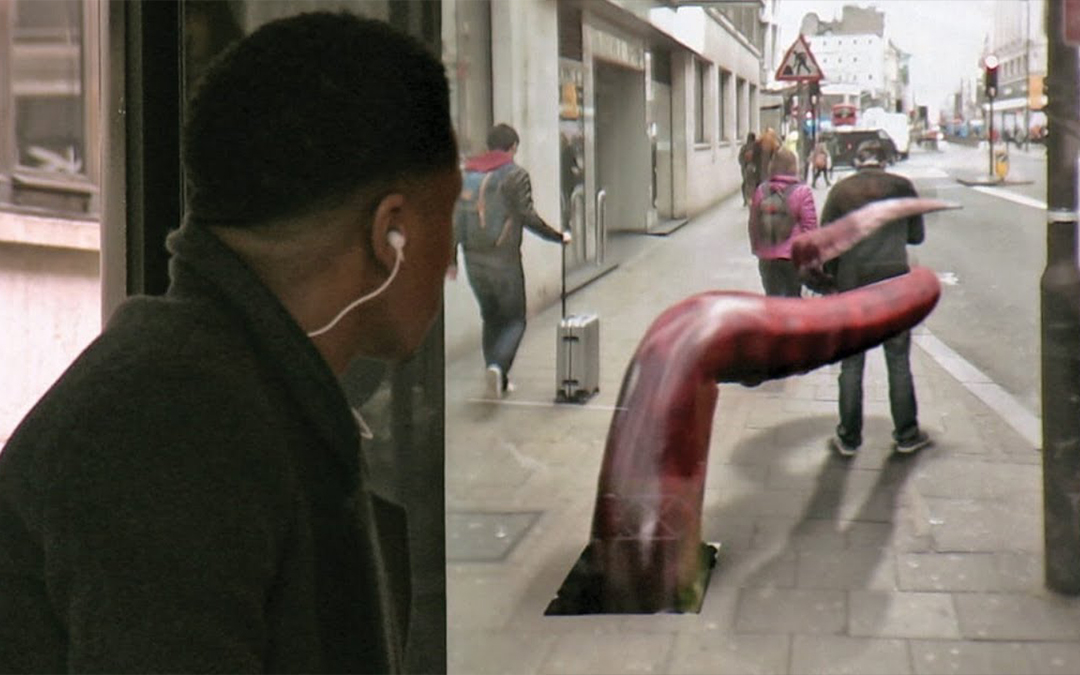
A tiger approaching a London bus shelter would normally be a reason to leave. In March 2014, it became part of a Pepsi MAX advertising campaign.
On New Oxford Street, people waiting for a bus appeared to witness extraordinary events unfolding nearby. Flying saucers descended, a tiger roamed the street, and a giant robot threatened an otherwise ordinary commute. The apparent emergencies were digital illusions.
The Pepsi MAX Unbelievable Bus Shelter campaign combined a live street view with computer-generated animation. A panel that appeared to be a transparent window became the stage for the action.
The resulting film attracted 8.5 million YouTube views, according to a retrospective published by production partner Little Dot Studios in November 2020. That is a historical reported figure, not a current view count.
For marketers, the useful question is how the physical experience, the brand idea, and the film worked together. Studying those connections offers more practical value than treating the campaign as a template for putting frightening creatures on public screens.
The brief: give “Unbelievable” a physical expression
The bus shelter belonged to a wider Pepsi MAX campaign built around the idea of the unbelievable.
Contemporary reporting by ClickZ described the brand strategy as connecting Pepsi MAX’s no-sugar, maximum-taste proposition with unexpected feats and experiences. The wider activity included consumer-created videos, outdoor placements, and a YouTube channel publishing new content each week.
The shelter gave that campaign idea a setting people already understood. A familiar part of the street appeared to behave in an impossible way.
This was an expression of brand personality rather than a demonstration of how the drink tasted. That distinction helps explain the creative decision. The experience needed to make “unbelievable” entertaining and recognizable, while the surrounding campaign connected that idea to Pepsi MAX.
Several partners contributed. A 2014 interview with Talon Outdoor’s Richard Simkins identifies Talon’s concept development alongside OMD UK and AMV BBDO, with Grand Visual producing digital content and JCDecaux providing media and hardware.
The useful planning principle is to start with a message that can become an experience. “Use augmented reality” is a production instruction. It does not yet explain what the audience should feel, understand, or remember.
How the Pepsi MAX AR bus shelter worked
The installation used a screen to make digitally altered street footage look like the view through a window.
Grand Visual describes adapting an existing digital poster display to show a live feed of the road ahead. Animated events appeared within that view, while a film crew captured the public’s reactions.
The illusion depended on how convincingly the animation fitted its surroundings. D&AD’s campaign archive records that the 3D animations were mapped over the environment and that a sensor adjusted them to match changing light conditions.
This was screen-based augmented reality. The spectacular events existed in the displayed image, rather than being projected into the open air. People could encounter the altered view through the shared display.
That makes the technical lesson quite specific: visual integration deserves as much attention as the animated object.
For a similar project, test how the camera view aligns with the surrounding architecture, where people will stand, and how the image looks under different lighting conditions. A polished animation in a studio preview should not be the only basis for approving an installation.
The production question is whether the complete illusion works at the actual site.
Why the creative choices suited the campaign
The published results do not isolate which design decisions caused people to watch or share. However, the execution offers several useful ways to think about experiential advertising.
The location helped tell the story
The campaign placed its extraordinary events within an everyday street scene. Its apparent window gave viewers a familiar starting point before the animated action appeared.
That structure made the idea easy to describe: people waiting for a bus seemed to witness something impossible.
A comparable campaign should make good use of its surroundings. Before adding a screen to a venue, ask what people expect to see there and how the creative could change that expectation.
A shop window, exhibition entrance, or visitor attraction may offer a useful setting. The test is whether the location contributes to the idea. When it does, the audience needs less explanation to understand what is happening.
People could encounter it without installing anything
Contemporary Mobile Marketer coverage, now hosted by Marketing Dive, highlighted that the activation removed the need to download an app to experience the content.
That matters as a design choice, even without a published comparison showing how much it affected participation.
For a brief public encounter, review every action you ask someone to take before the experience begins. Registration, instructions, or a download should have a clear purpose. They should not appear simply because the technology allows them.
An optional next step can follow the experience. A person who has already enjoyed an installation may have a reason to explore a related offer or learn more. Requiring that action beforehand creates a different proposition, which should be tested on its own merits.
The film was part of the plan
Little Dot Studios says its brief was to help take the bus shelter campaign beyond its outdoor placement and into online circulation. The recorded reactions became the accompanying YouTube film.
The wider Pepsi MAX campaign already treated YouTube as a significant entertainment channel, according to AMV BBDO’s comments reported by ClickZ. The shelter therefore sat within an existing content approach.
This is one of the most useful lessons for campaign planning: design for the participant and the remote viewer.
The participant needs an experience that works in the moment. Someone watching later needs enough context to understand the setup, see the event, and recognize the brand behind it.
Plan camera positions and the edit before launch. A reaction close-up may be entertaining, but without a clear view of what caused it, the campaign idea can become difficult to follow.
What results were actually reported?
The clearest published evidence concerns video viewing and creative recognition.
Grand Visual reports that the campaign reached 3 million YouTube views in five days. Its retrospective also describes an eventual total of more than 8 million views.
Little Dot Studios’ November 2020 account gives a figure of 8.5 million views for the accompanying film. These are reports about the same campaign’s online audience, not separate totals to add together.
The campaign also appears in D&AD’s 2015 awards archive, with recognition in Press & Outdoor and Digital Experience Design. The award year should not be confused with the campaign’s 2014 launch.
Those results support a clear conclusion: the filmed activation attracted substantial viewing and received industry recognition.
They do not establish how many unique people experienced the shelter, how many viewers remembered Pepsi MAX, or how much incremental profit the installation generated.
In his 2014 interview, Simkins discussed sales success in the context of a wider multimedia campaign. That account does not isolate the bus shelter’s contribution.
The distinction matters when using this case to justify another project. A widely viewed campaign film is evidence of distribution. Establishing sales impact requires an additional measurement approach.
The production lesson behind the illusion
The visible screen was only one part of the work.
Simkins described detailed mapping of the street environment as a requirement for realism and a limitation on scaling the approach. He also said creative work, production, and public relations cost significantly more than the media placement. He did not disclose a total budget in that interview.
For a team developing a comparable concept, that suggests a different budgeting conversation from simply asking what a screen costs.
Account for site preparation, content production, on-location testing, operational support, filming, editing, and distribution. Decide who is responsible when the display works technically but the illusion looks wrong.
Also define a fallback experience. A conventional branded display may be a better response to a technical fault than leaving a frozen camera feed visible.
Treat those decisions as part of the creative production. They determine what the public actually encounters.
How a smaller campaign could apply the idea
A useful adaptation would preserve the connection between the setting, the experience, and the message. It would not need to reproduce the London stunt.
Consider a hypothetical museum promoting a prehistoric-life exhibition.
The museum could create a digital “window” overlooking its courtyard. Visitors would see a live view of the space with a prehistoric animal appearing to move through it. A clear reveal would connect the creature to the exhibition, followed by an optional route to tickets or further information.
The animal would have a direct relationship to what the museum offers. The installation could help introduce the exhibition rather than operating as an unrelated spectacle.
Start with one scene and one viewing area. Test whether visitors understand the effect and can identify the exhibition it promotes before producing additional animations.
A smaller team should also make deliberate choices about participation. An invited experience in a controlled venue may suit the project better than surprising unsuspecting people beside a road.
Plan for accessible viewing positions, clear pedestrian routes, and people who prefer not to participate. Where reactions will be filmed for publication, establish an appropriate participant-consent process with the production team.
The goal should be an enjoyable experience that people are comfortable seeing shared.
How to measure a campaign inspired by this case
Set the measurement plan before the installation opens. Keep the live experience, its content distribution, and any business outcome distinguishable.
For the installation, define what counts as participation. Someone passing the screen is different from someone stopping to watch a complete sequence. Observe both, then use a short audience check to learn whether participants understood the message and correctly identified the brand.
For the film, examine completion and sharing alongside views. Where possible, separate paid distribution from other viewing so that the team understands how the audience was reached. Test the edit for brand recognition rather than assuming that enjoying the clip means remembering its sponsor.
For a commercial outcome, choose a relevant action. In the hypothetical museum example, that might be a ticket purchase or a visit to the exhibition information page. A dedicated code or link can help track responses, but tracked responses alone do not prove how many additional purchases the campaign caused.
To estimate incremental impact, plan a suitable comparison, such as comparable locations or periods, while accounting for other activity that could affect the result.
Do not combine foot traffic, video views, and possible media exposure into a single audience figure. Each answers a different question.
What to take into the next creative brief
The most useful reading of the Pepsi MAX bus shelter campaign is that every major element had a role. The setting established an ordinary scene. The illusion gave the campaign’s “Unbelievable” idea a physical expression. The film allowed people elsewhere to understand and enjoy the encounter. That interpretation follows the documented creative and distribution approach.