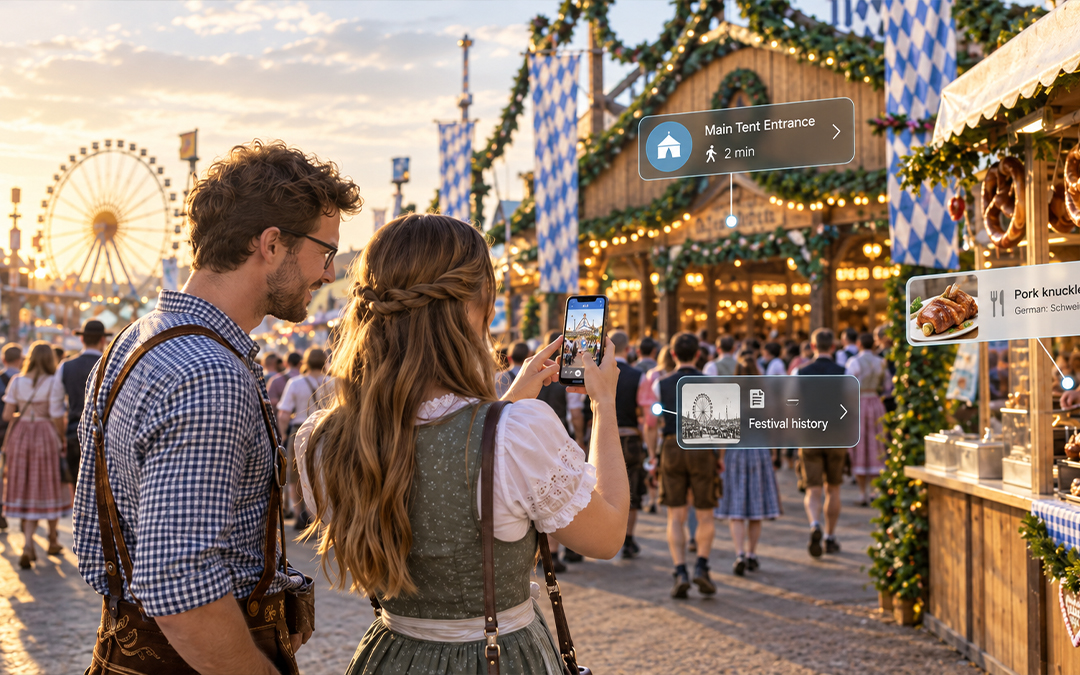
Finding the right tent, choosing something to eat, and discovering the stories behind a celebration should be enjoyable parts of a festival visit. An augmented reality experience could make those moments easier, while giving visitors something memorable to explore.
Augmented reality at Oktoberfest could help people identify entrances, understand unfamiliar menus, explore Bavarian traditions, and enjoy short interactive activities. Its most useful role would be connecting information and entertainment to the places and objects already around them.
The challenge is knowing when to use it. A historical scene appearing over a festival display could add something special. A complicated camera interface for checking an opening time probably would not.
A better Oktoberfest experience should leave more room for the celebration itself.
What is Oktoberfest?
Oktoberfest is Munich’s annual folk festival, held on the Theresienwiese, the grounds also known locally as the Wiesn. Its origins date to 1810, when celebrations for the wedding of Ludwig, the future King Ludwig I of Bavaria, and Princess Therese included a horse race. Over time, beer halls, food stalls, music, and fairground attractions helped shape the festival familiar today.
The Munich event takes place from 19 September to 4 October in 2026.
That history provides an important starting point for any digital addition. An Oktoberfest AR experience should help visitors understand and enjoy the festival’s character, rather than treating the grounds as a blank space for generic games or advertising.
The Munich applications discussed below are proposals for future experiences, not confirmed features of Oktoberfest 2026. A documented example from Oktoberfest in Blumenau, Brazil, shows how AR has already been used at a related celebration.
What would augmented reality look like at Oktoberfest?
Augmented reality adds digital content to a view of the physical world. On a smartphone, it can combine the camera image with text, animation, or three-dimensional objects positioned to appear connected to the surroundings.
At Oktoberfest, a visitor might point a compatible phone at a participating information board and see a historical scene appear over it. At a tent entrance, an AR label could help identify the place they are looking for.
The connection to the physical setting matters. A QR code that opens a normal menu is a useful digital service, but it is not, by itself, an AR experience. AR adds value when seeing information attached to an actual object or location makes something clearer or more interesting.
Six ways augmented reality could improve Oktoberfest
1. Help visitors identify the right tent or entrance
AR could make the final stage of finding a destination more straightforward: recognising the correct entrance once a visitor is nearby.
Oktoberfest already provides an official site map. An AR guide could complement conventional wayfinding by displaying a tent’s name over a participating entrance or highlighting a verified information point.
For example, a visitor could choose a destination on a standard map, walk toward it with their phone put away, then stop in a suitable area and briefly use the camera to confirm the entrance. That would be a more considered design than encouraging people to follow floating arrows continuously through the crowds.
Tent-admission information could be useful too, but it would require a separate, reliable source of updates. The official visitor barometer describes expected busy periods based on experience; it should not be mistaken for live tent-capacity data.
Any proposed admission-status feature should identify its source, display when it was updated, and show when information is unavailable. An AR label should never imply that entry is guaranteed.
2. Make menus easier to understand
An AR menu could connect unfamiliar food names with clear explanations in a visitor’s preferred language.
At a participating stall, guests could point their phone at a menu board and see approved translations appear beside the relevant items. A dish could reveal a photograph, a short description, and the current price. Visitors could also choose to highlight available vegetarian options or alcohol-free drinks.
The goal would be to help someone decide what to order without repeatedly switching between a menu, a translation tool, and a separate website.
Accuracy would need to come before visual effects. Vendors should supply and approve descriptions, prices, and dietary information. An experience should never infer allergens from a food photograph or treat an automatic translation as a substitute for checking requirements with staff.
AR would not be necessary for every menu. Where a clearly written mobile page answers the question faster, that should remain the default. The camera view should offer a useful alternative, not introduce another obstacle to ordering lunch.
3. Bring the festival’s history into the surroundings
Historical storytelling offers a particularly natural use for AR because it can connect a place with something visitors can no longer see there.
An experience could invite guests to stand at a designated viewing point and explore a researched reconstruction of the early festival. Another could place an archival photograph over a contemporary view, allowing people to compare the scenes.
The contrast would have genuine historical substance. The first Oktoberfest celebrations did not feature the beer tents and fairground rides associated with the event today.
Smaller stories could be just as engaging as a large reconstruction. A display might introduce the craft behind a traditional fairground attraction, explain an instrument visitors have heard, or present an interview with someone who runs a festival business.
These experiences should distinguish archival evidence from artistic interpretation. A reconstructed scene should be labelled as a reconstruction, with historians or relevant cultural organisations involved in checking the content.
The opportunity is to help visitors notice more of the real festival after they lower their phones.
4. Make accessibility information easier to find
AR could help visitors locate facilities that meet their needs, provided the underlying information is verified.
Munich’s official accessibility guidance describes existing provisions including accessible entrances at large tents, wheelchair spaces, accessible toilets, and Braille menus at participating businesses.
A proposed guide could highlight the relevant step-free entrance rather than simply directing someone toward the nearest door. A visitor exploring an attraction could check its access arrangements before travelling across the grounds.
However, visual overlays alone would not make the experience accessible. The same information should be available through readable text, screen-reader-compatible controls, captions, and a conventional map. Essential services should not depend on holding up a phone or successfully tracking an AR marker.
Route information would also need review by people familiar with the actual grounds and by visitors with different access requirements. An attractive digital arrow is no substitute for a route that someone can use.
5. Offer playful activities without keeping families on screens
A short AR discovery trail could give families another way to explore together.
One possible concept would be a digital festival passport. At selected stopping points, visitors could reveal an animation, answer a question about something nearby, or collect a virtual symbol associated with a cultural story.
A good challenge would encourage attention to the surroundings. Rather than tapping rapidly on a screen, a participant might identify a detail on a display and then reveal an explanation.
The activity should be easy to pause and possible to complete in any order. There should be no reward for rushing, walking while watching the camera, or competing to reach crowded locations first.
Family experiences should also remain separate from alcohol promotions. Rewards could recognise curiosity and participation through a digital postcard or certificate, without requiring purchases or encouraging consumption.
The aim would be a shared moment of discovery, followed by time to enjoy the attractions themselves.
6. Create souvenirs with a story to revisit
AR could extend the meaning of a souvenir beyond the day it was bought.
A participating postcard, for example, could reveal a miniature animated festival scene when viewed through a compatible experience. A craft display could show part of the making process, helping visitors understand the work behind the object in front of them.
These ideas have a practical technical foundation: image-recognition systems such as Google’s ARCore Augmented Images can recognise prepared reference images, including posters or packaging, and attach digital content to them.
For an Oktoberfest project, the creative value would come from the content. An interview with a maker or a carefully illustrated story could be more memorable than placing an unrelated animation over a logo.
The souvenir should still work without AR. Its digital element would be an optional addition, with no requirement to create a public profile or share photographs on social media.
A real example: augmented reality at Oktoberfest in Blumenau
Oktoberfest-related AR is not entirely hypothetical.
Creative studio Cafundó documents an experience developed with marketing agency Guru 360 for Spaten at Oktoberfest in Blumenau, Brazil. Visitors interacted with four installations across festival pavilions, revealing AR animations and collecting digital emblems. Completing the collection qualified participants for a branded beer mug. The studio says the experience used browser-based AR without requiring an app download.
Cafundó reports more than 5,000 participants and the distribution of 3,000 mugs. These are the creator’s reported figures, not independent findings about visitor satisfaction or the wider festival experience.
This was a branded activation in Brazil, not an official AR navigation system at Munich’s Oktoberfest.
For future projects, the useful idea to borrow is the focused interaction: a recognisable stopping point, a brief experience, and a clear reason to participate. Whether that approach improves a particular festival visit should be tested rather than assumed.
What would make an Oktoberfest AR experience work?
Keep camera use brief and consider the surroundings
Festival conditions deserve careful testing. Google’s AR guidance identifies crowded public spaces as challenging for tracking and warns that poor lighting, extremely bright conditions, and moving surfaces can interfere with environmental understanding.
Its safety guidance also recommends maintaining awareness of the surroundings, avoiding interactions that require walking backward, and providing breaks during longer experiences.
For Oktoberfest, that suggests short interactions at approved stopping areas. An experience should not encourage people to gather in front of entrances, step into a queue, or keep watching their camera while moving through busy pedestrian routes.
When tracking fails, the interface should offer a normal information page instead of asking someone to keep waving their phone around.
Make essential information available without AR
Maps, opening information, accessibility details, and vendor descriptions should remain usable without a camera.
A project should include a straightforward mobile alternative and, where practical, downloadable information. Visitors should also be able to reach useful content without registering for an account.
Compatibility needs testing on the actual devices and browsers the project intends to support. A smartphone-first design is a sensible starting proposal; specialist eyewear should not be a requirement for receiving basic visitor information.
The same principle applies to content complexity. A short, relevant animation is a better pilot candidate than a large experience that visitors struggle to open or understand.
Give every piece of changing information an owner
A historical story and a tent-admission update have very different maintenance needs.
Before publishing an operational feature, someone should be responsible for checking it, updating it, and removing it when it becomes unreliable. Prices, entrances, and access arrangements should not remain visible indefinitely simply because the digital overlay still works.
Privacy should also be addressed early. Camera access should have a clear purpose. Unnecessary image storage and continuous location collection should be avoided. Any optional location-sharing feature should explain who can see the information and when sharing ends.
Organisers should also secure permission for signs, installation locations, archival material, and brand assets before development begins.
Start with one experience worth testing
A future Oktoberfest AR project does not need to cover the entire festival.
A manageable pilot could focus on a single historical display, supported by a short mobile explanation for visitors who cannot or prefer not to use AR. Another could test whether entrance identification helps people recognise their destination more confidently than a map alone.
The evaluation should match the purpose. For wayfinding, measure successful destination identification and confusion. For a cultural experience, ask what visitors understood and whether the interaction added to their visit.
Opening the experience is only the beginning. Downloads, scans, and participation totals do not answer every question about usefulness.
Keep the celebration at the centre
Augmented reality could make Oktoberfest easier to explore and richer to understand. It could connect a visitor with a historical scene, explain a dish at the moment of ordering, or help someone identify an entrance that meets their needs.
Those improvements depend on thoughtful choices: accurate information, short interactions, accessible alternatives, and content that belongs at the festival.
The most valuable Oktoberfest AR experience would earn its place by helping visitors enjoy what is already there. Once it has answered the question or told the story, it should be easy to put the phone away and return to the celebration.